
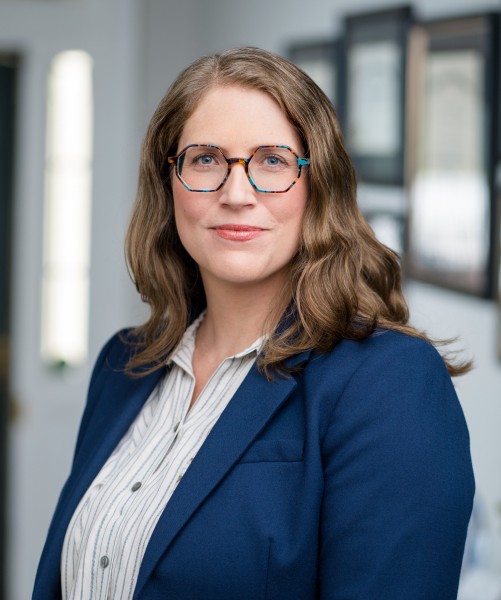
Ellen Chapman

Cultural Resources Specialist

434.327.6663

About Ellen

Ellen brings deep experience in historic preservation and archaeological cultural resources laws and regulations, with a focus on supporting Tribes, descendant communities, and other stakeholders through complex regulatory processes. Since 2016, she has supported CHP clients navigating the National Historic Preservation Act (NHPA), National Environmental Policy Act (NEPA), Native American Graves Protection and Repatriation Act (NAGPRA), and state and local preservation laws.


Ellen provides analysis and advice to clients to advance their protection of archaeological heritage important to them and to obtain meaningful mitigation if sites are lost or damaged. Her work has addressed unpermitted construction damage, fraudulent archaeological reporting, violations of burial laws, and deficient agency consultation practices. As a member of the Council of Virginia Archaeologists DHR Guidelines Committee, she has worked to improve the robustness of archaeological regulations to provide a level playing field in the cultural resources management industry.

With a background in public archaeology and the treatment of archaeological human remains, Ellen is deeply committed to advancing Tribal and descendant community leadership in decision-making regarding archaeological sites and sacred places. She has helped several Tribal Nations protect traditional cultural places and burial sites, ensuring that these places are sufficiently evaluated and legally protected.


Prior to joining CHP, Ellen worked in archaeological field and lab settings across California, Virginia, Missouri, Nevada, India, and the United Kingdom. She led the 2016 National Park Service’s Urban Archaeology Corps program in Richmond, Virginia, and created Colonial Williamsburg’s first replica of an 18th-century articulated skeleton. Since 2018, she has been part of a multidisciplinary advocacy coalition to protect the Shockoe Hill African Burying Ground, the largest documented burial ground for enslaved and free people of color in the United States.


Education

PhD in Anthropology, The College of William & Mary, 2018

MSc in Palaeopathology, Durham University, 2010

BA in Archaeology, Washington University in St. Louis, 2005
REPRESENTATIVE ENGAGEMENTS

  • For a federally recognized American Indian tribe, secure rights to meaningful consultation with a federal agency and oppose plans by a municipal board to construct water pumping facilities on the historic capital city of the tribe–to prevent disturbing ancestral burials and cultural resources.
  • For a real estate developer, advise on strategies for compliance with historic preservation regulations to ensure success of historic rehabilitation tax project.
  • For an American Indian tribe, recommend strategies for ensuring the tribe is consulted in federal permitting decisions that affect their cultural resources, environment, and members.
  • For more than 350,000 heritage professionals, scholars, small businesses, nonprofit groups, and history-lovers from across the U.S., empower, inform and train advocates to support and promote the nation’s commitment to historic preservation.
  • For a national association of cultural resource management (CRM) professionals and small business owners, represent their interests to Congress and federal agencies to ensure the continued growth and success of the CRM industry.
  • For a consortium of leading national preservation organizations, develop a distance learning leadership program to facilitate skill-building and position emerging historic preservation leaders for success.

PRESENTATIONS

  • Presenter, Towards a “Conciliatory Archaeology”: Developing Approaches for Restorative Justice and Reparations in Archaeology, Society for Historical Archaeology Annual Conference (Boston, MA; January 2020).
  • Presenter, Digging Out after Decades of Fast Capitalism: Addressing Richmond’s Incomplete Archaeological Legacy Through Community-Based Projects and Advocacy, Society for Historical Archaeology Annual Conference (Boston, MA; January 2020).
  • Presenter, “A Monumental Blunder”: The Challenging History and Uncertain Future of the Virginia State Penitentiary Collection, Society of Historical Archaeology Annual Conference (St. Charles, MO; January 2019).
  • Presenter, Industrial Heritage as Community Amenity: The Integration of Industrial Fabric within the James River Park System in Richmond, Virginia, Society for Industrial Archaeology Annual Conference, (Richmond, VA; June 2018).
  • Presenter, Making Urban Archaeology Municipal: Mapping Archaeological Sensitivity in Richmond, Virginia, Society of Historical Archaeology Annual Conference, (New Orleans, LA; January 5, 2018).
  • Invited Panelist, “Meet Me in the Bottom: Film Viewing and Panel Discussion.” Created Equal Film Series at the Virginia Historical Society, (Richmond, VA; June 2015).
  • Invited Presenter, “Under the River City: Exploring the History and Promise of Richmond’s Archaeology.” Public Session of the Archaeological Society of Virginia Annual Meeting, (Richmond, VA; October 2014).

PUBLICATIONS

  • Author, A Monumental Absence: Race, Politics, and the Archaeology of Richmond, University of Alabama Press (Forthcoming in 2022).
  • Co-Author, “Bones in Stasis: The Challenging History and Uncertain Future of the Virginia State Penitentiary Collection.” Journal of North American Anthropology. With Ana Edwards and Elizabeth Cook. 2020.
  • Author, “‘Useful Ornaments to His Cabinet’: Analysis of Anatomical Study and Display in Colonial Williamsburg,” in Archaeology in Williamsburg: Embodying Space and Creating Works of Consequence (2020).
  • Co-Author, “Heritage in the Global Economy: Protecting Cultural Heritage through Nongovernmental and Voluntary Practices,” in Relevance and Application of Heritage in Contemporary Society (2018).
  • Author, Archaeological Survey and Testing at Chimborazo Park (44HE0997), Richmond, Virginia, for Richmond National Battlefield Park (2017).
  • Co-Author, “A Dissection at the Coffeehouse? The Performance of Anatomical Expertise in Colonial America,” in Bioarchaeology of Dissection and Autopsy in the United States (2016).
  • Author, “Richmond’s Archaeology of the African Diaspora: Unseen Knowledge, Untapped Potential,” in Historic Black Lives Matter: Archaeology as Activism in the 21st Century (2015).
  • Author, “Book review of The Archaeology of American Cities,” Journal of Mid-Atlantic Archaeology (2015).
  • Author, “Preliminary Analysis of Human Remains Recovered from St Peter’s Church, St George’s, Bermuda,” submitted to the Bermuda National Trust (2012).
  • Author, “Bell/Dickinson Cemetery – Brief Summary Report of Investigations in June 2011,” (2012).

MEMBERSHIPS

  • Society for Historical Archaeology
  • Council for Northeast Historical Archaeologists
  • Council of Virginia Archaeologists, Legislative Affairs Committee

PRESS